Respire Bracelet
Respire Bracelet
A wearable breathing companion for chronic respiratory patients.
A wearable breathing companion for chronic respiratory patients.
Role:
Role:
Product designer
Product designer
Time
Time
2023
2023
Tools:
Tools:
UIUX, 3D Modeling, Prototype, User research
UIUX, 3D Modeling, Prototype, User research
Team
Team
Just me!
Just me!
PROBLEM:
PROBLEM:
Emergency response for chronic respiratory diseases is complicated, and long-term management remains fragmented.
Emergency response for chronic respiratory diseases is complicated, and long-term management remains fragmented.
Inhalers require technique and precision, Daily care depends on multiple touchpoints: devices, reminders, apps, consultations.
Inhalers require technique and precision, Daily care depends on multiple touchpoints: devices, reminders, apps, consultations.
SOLUTION:
SOLUTION:
An integrated wearable system that bridges acute intervention and long-term care.
An integrated wearable system that bridges acute intervention and long-term care.
This project proposes a respiratory wearable that unifies “rescue” and “management” into one continuous, intuitive experience.
This project proposes a respiratory wearable that unifies “rescue” and “management” into one continuous, intuitive experience.
HIGHLIGHTS:
HIGHLIGHTS:
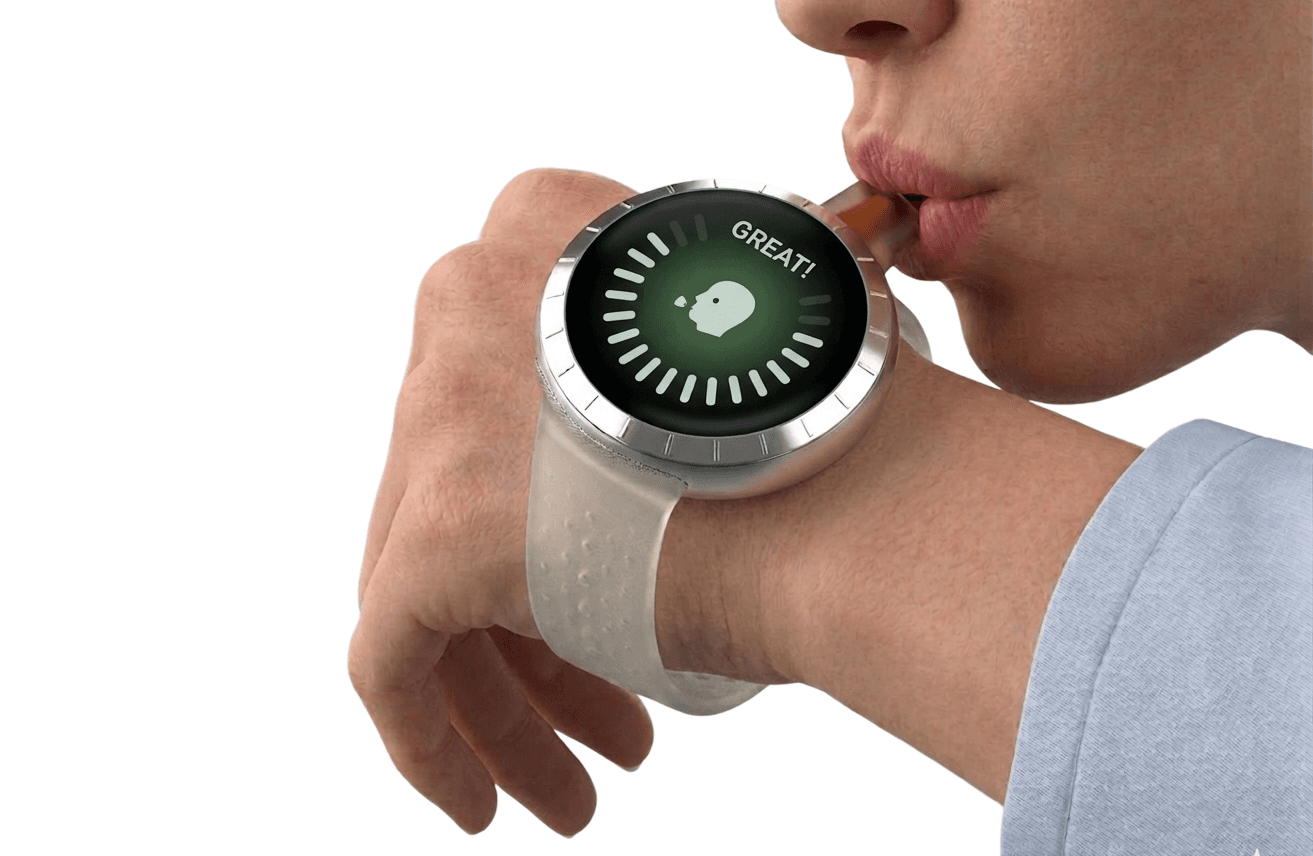
A New Way to Inhale
The act of inhalation is restructured into something simple, intuitive, and perceptible.
One-Stop Management
Behaviors once scattered across platforms—are consolidated into a unified system.
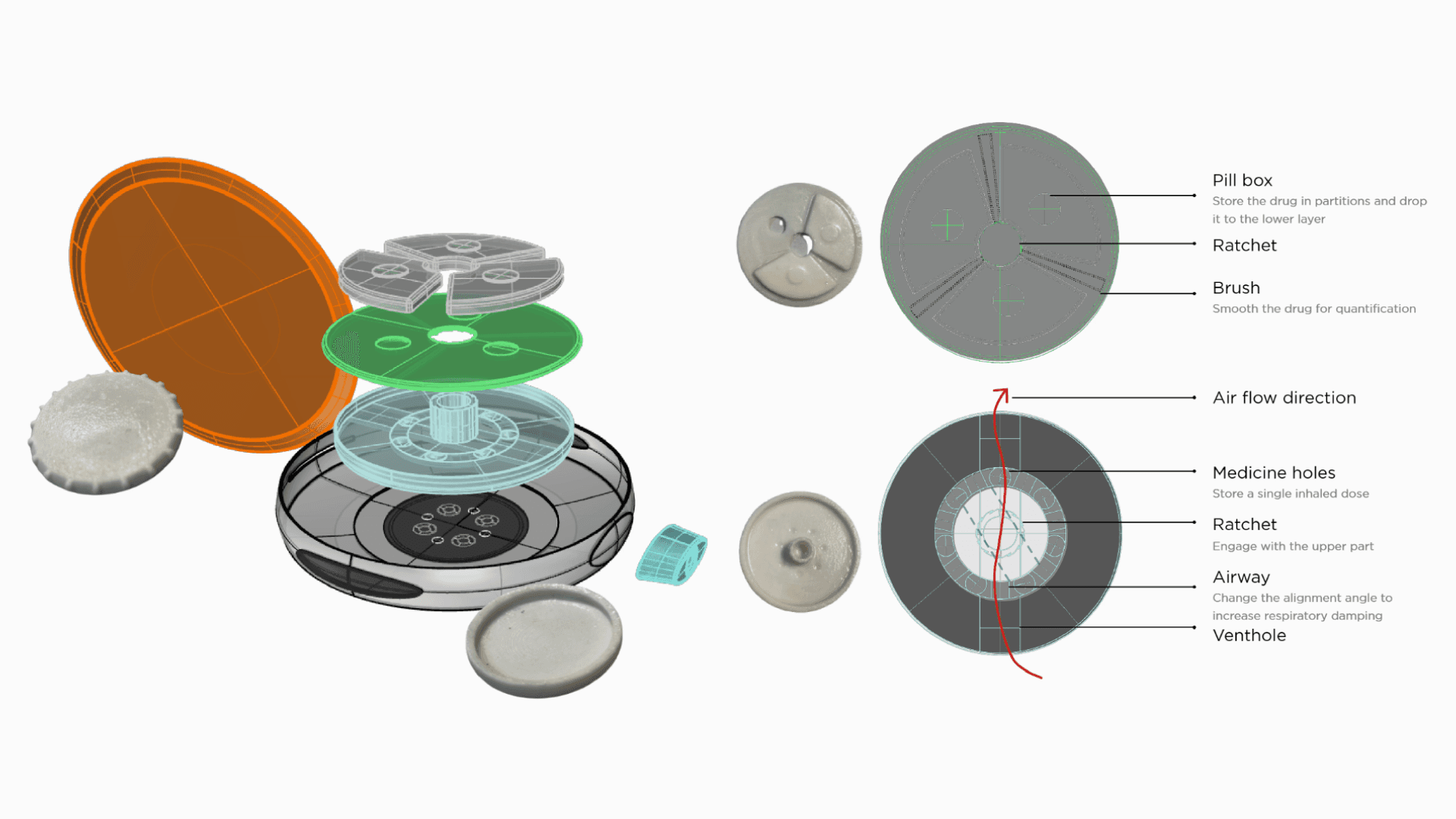
Mechanical Reliability at the Core
The core intervention remains purely mechanical—independent, dependable, immediate.
In acute moments, reliability is safety.
Show Identity, Not a Medical Label
Customizable modular exterior, an extension of personal expression rather than a marker of illness.
INITIAL OBSERVATION:
INITIAL OBSERVATION:
There is no convenient, intuitive way to manage respiratory conditions.
There is no convenient, intuitive way to manage respiratory conditions.
Early observation of patients around me revealed a pattern:
daily life is stitched together by multiple tools, scattered behaviors, and constant vigilance.
Even the inhaler itself—seemingly simple—demands more coordination than it appears.
Early observation of patients around me revealed a pattern:
daily life is stitched together by multiple tools, scattered behaviors, and constant vigilance.
Even the inhaler itself—seemingly simple—demands more coordination than it appears.
PAIN POINTS
PAIN POINTS
Using an Inhaler Correctly Is Surprisingly Difficult
Using an Inhaler Correctly Is Surprisingly Difficult
Breath timing, actuation coordination, inhalation depth— small errors reduce effectiveness.
Studies suggest up to 70% of patients misuse inhalers. Children are especially affected.
Breath timing, actuation coordination, inhalation depth— small errors reduce effectiveness.
Studies suggest up to 70% of patients misuse inhalers. Children are especially affected.
Daily Management Is Complex and Dispersed
Daily Management Is Complex and Dispersed
Medication, monitoring, logging, consultation— spread across different objects and apps.
The system is divided.
The patient connects the pieces.
Medication, monitoring, logging, consultation— spread across different objects and apps.
The system is divided.
The patient connects the pieces.
INSIGHTS:
INSIGHTS:
We need an integrated system that bridges acute intervention and long-term care.
We need an integrated system that bridges acute intervention and long-term care.
RESEARCH:
RESEARCH:
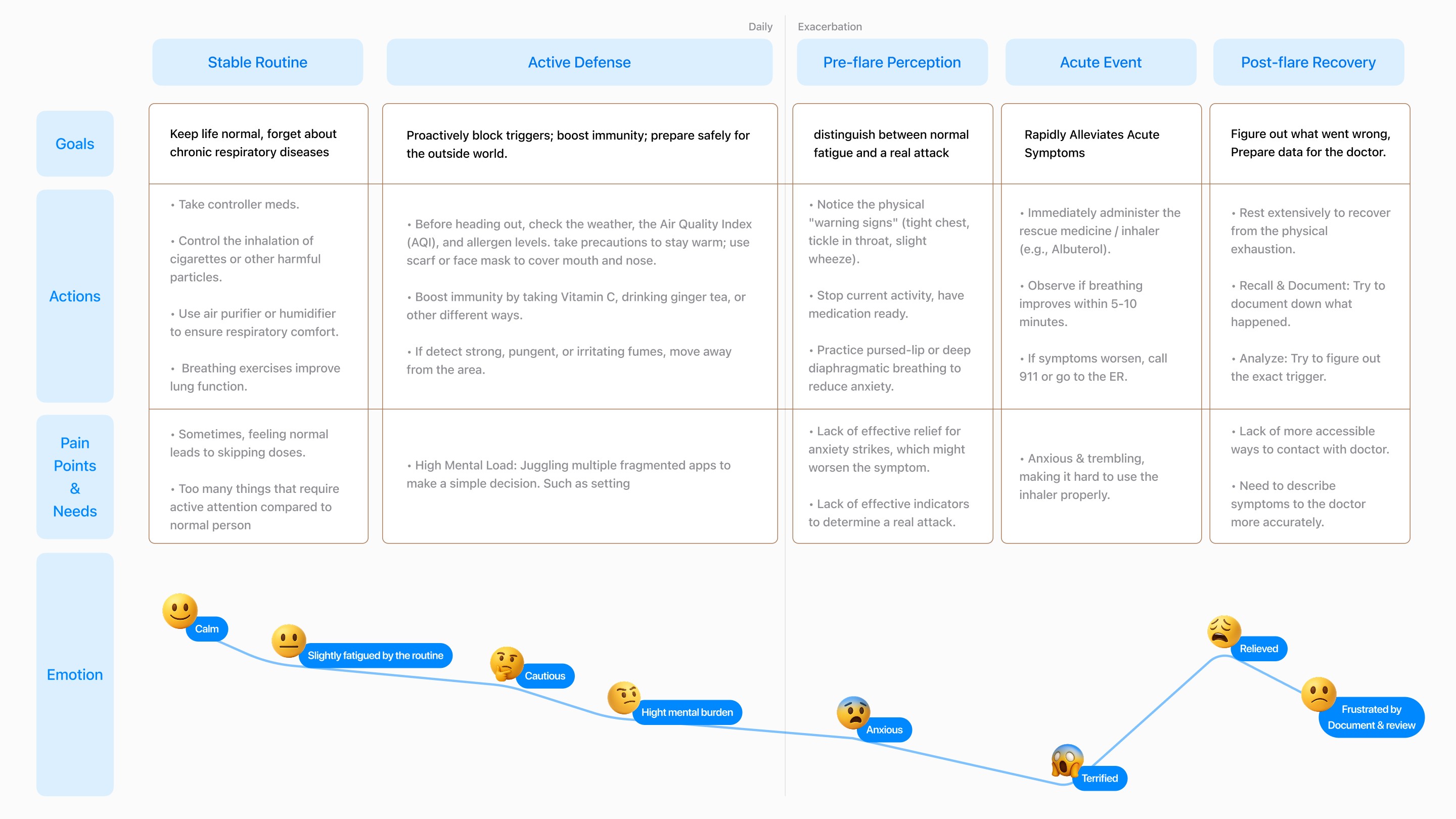
By mapping a typical patient journey, I realized that wearable devices could serve as an ideal entry point for building an integrated system.
From a functional perspective, they are capable of supporting most aspects of digital disease management—such as physiological monitoring, alerts, data logging, and reminders.
However, one critical element is missing: the ability to directly intervene.
Therefore, the initial concept was straightforward:
leverage existing wearable technologies to support disease management at a digital level, and build upon this foundation by integrating intelligent inhalation capabilities.
By mapping a typical patient journey, I realized that wearable devices could serve as an ideal entry point for building an integrated system.
From a functional perspective, they are capable of supporting most aspects of digital disease management—such as physiological monitoring, alerts, data logging, and reminders.
However, one critical element is missing: the ability to directly intervene.
Therefore, the initial concept was straightforward:
leverage existing wearable technologies to support disease management at a digital level, and build upon this foundation by integrating intelligent inhalation capabilities.
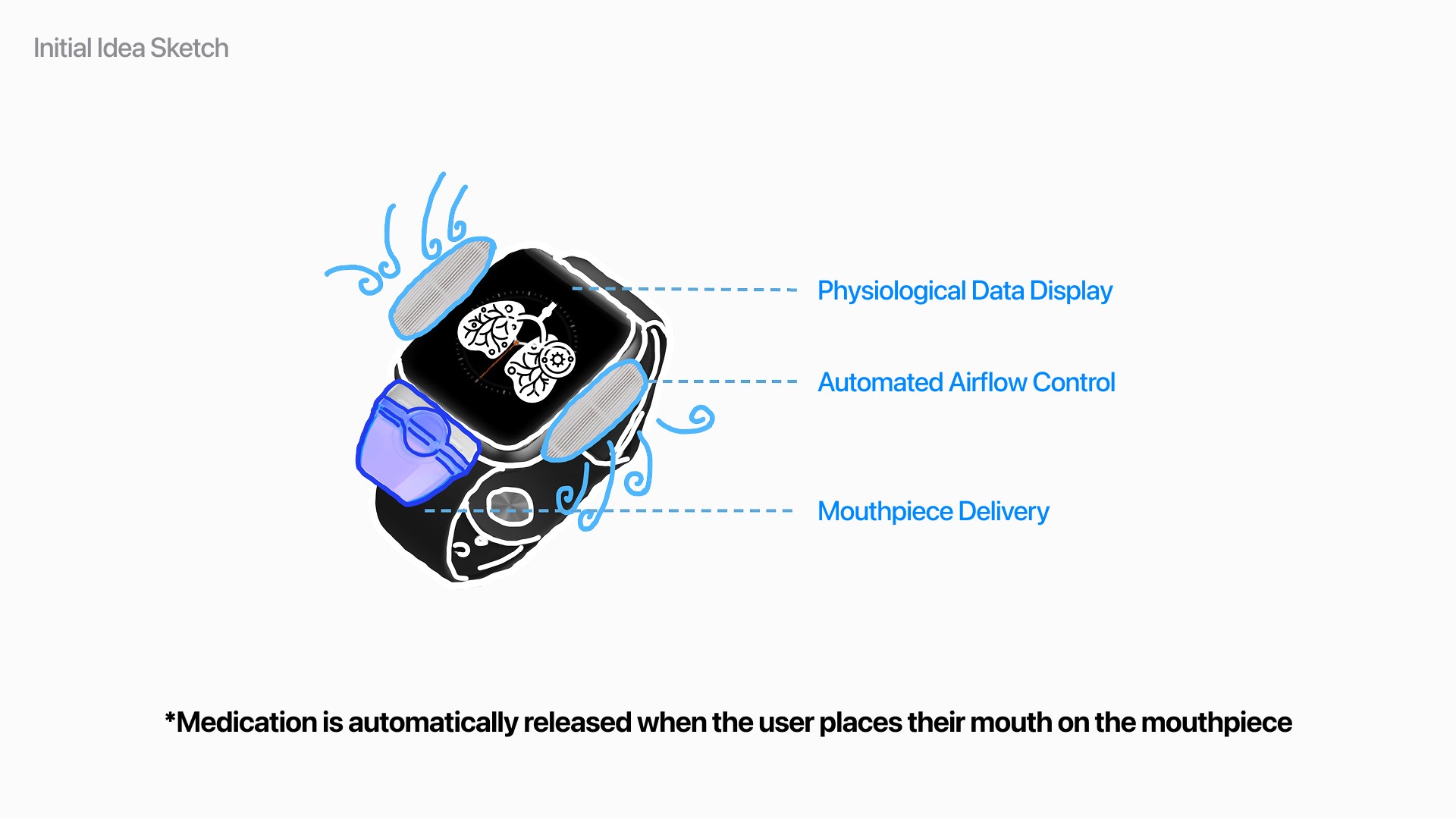
However, when this concept was presented to clinicians and patients, the feedback shifted the direction entirely:
However, when this concept was presented to clinicians and patients, the feedback shifted the direction entirely:
EXPERTS:
EXPERTS:
Inhalers are not electronic for a reason. Mechanical structures guarantee reliability.
Inhalers are not electronic for a reason. Mechanical structures guarantee reliability.
Mechanical structures function without power, and withstand extreme conditions.
In emergency scenarios, stability is non-negotiable, reliability is not a feature, it is safety.
Mechanical structures function without power, and withstand extreme conditions.
In emergency scenarios, stability is non-negotiable, reliability is not a feature, it is safety.
PATIENTS:
PATIENTS:
Medical device must not become a label of illness.
Medical device must not become a label of illness.
While patients welcomed the idea of an integrated management system, they worried about if medical wearable immediately signal illness, and turn their condition into a public identity?
While patients welcomed the idea of an integrated management system, they worried about if medical wearable immediately signal illness, and turn their condition into a public identity?
How might we design a wearable respiratory system that preserves mechanical reliability in emergencies while enabling intelligent long-term management?
How might we design a wearable respiratory system that preserves mechanical reliability in emergencies while enabling intelligent long-term management?
&
How might we make this product become a tool for personalized expression, rather than a label for illness?
How might we make this product become a tool for personalized expression, rather than a label for illness?
DESIGN PROCESS: PHYSICAL PART
DESIGN PROCESS: PHYSICAL PART
Semi-mechanical, semi-electronic structure with modular and detachable design
Semi-mechanical, semi-electronic structure with modular and detachable design
Through investigation of current inhalation device's structure, I decide to make an integration, the inhale part were fully mechanical, to make sure it functions perfectly under any circumstances. while the electronic part only monitor the dosage and leftover of the medicine.
Through investigation of current inhalation device's structure, I decide to make an integration, the inhale part were fully mechanical, to make sure it functions perfectly under any circumstances. while the electronic part only monitor the dosage and leftover of the medicine.
DESIGN PROCESS: DIGITAL PART
DESIGN PROCESS: DIGITAL PART
A 24/7 online one-stop management system
A 24/7 online one-stop management system
Furthermore, the digital part enhances the traditional inhalation process, ensuring that users effectively inhale their medication.
FINAL OUTCOME:
FINAL OUTCOME:
Introducing Respire Bracelet
Introducing Respire Bracelet
Mapping a typical patient journey makes me realized that, functionally, the watch could already support almost the entire digital layer of respiratory management, and the only missing piece was direct intervention.
So the initial idea was straightforward:
What if medication delivery itself became integrated—electronic, intelligent, seamless?
Mapping a typical patient journey makes me realized that, functionally, the watch could already support almost the entire digital layer of respiratory management, and the only missing piece was direct intervention.
So the initial idea was straightforward:
What if medication delivery itself became integrated—electronic, intelligent, seamless?
REFLECTION
REFLECTION
What I learned
What I learned
More Intelligence Isn't Always Better
More Intelligence Isn't Always Better
Conversations with clinicians shifted my design from a fully electronic concept to a hybrid mechanical–digital interaction. In healthcare, reducing cognitive load and preserving familiar physical behaviors often creates a more trustworthy experience than adding more technology.
Conversations with clinicians shifted my design from a fully electronic concept to a hybrid mechanical–digital interaction. In healthcare, reducing cognitive load and preserving familiar physical behaviors often creates a more trustworthy experience than adding more technology.
Healthcare UX Is About Behavior, Not Single Interactions
Healthcare UX Is About Behavior, Not Single Interactions
I learned that successful asthma care depends less on performing one inhalation correctly and more on building sustainable daily routines. Designing for long-term adherence became more important than optimizing a single interaction.
I learned that successful asthma care depends less on performing one inhalation correctly and more on building sustainable daily routines. Designing for long-term adherence became more important than optimizing a single interaction.